
Is Rumpelstiltskin (1987) a Real Movie? Viral Clip Explained
Yes, a real Rumpelstiltskin movie came out in 1987. But the viral tiptoe dance clip is not from it. The real Cannon film vs. the AI video, side by side.
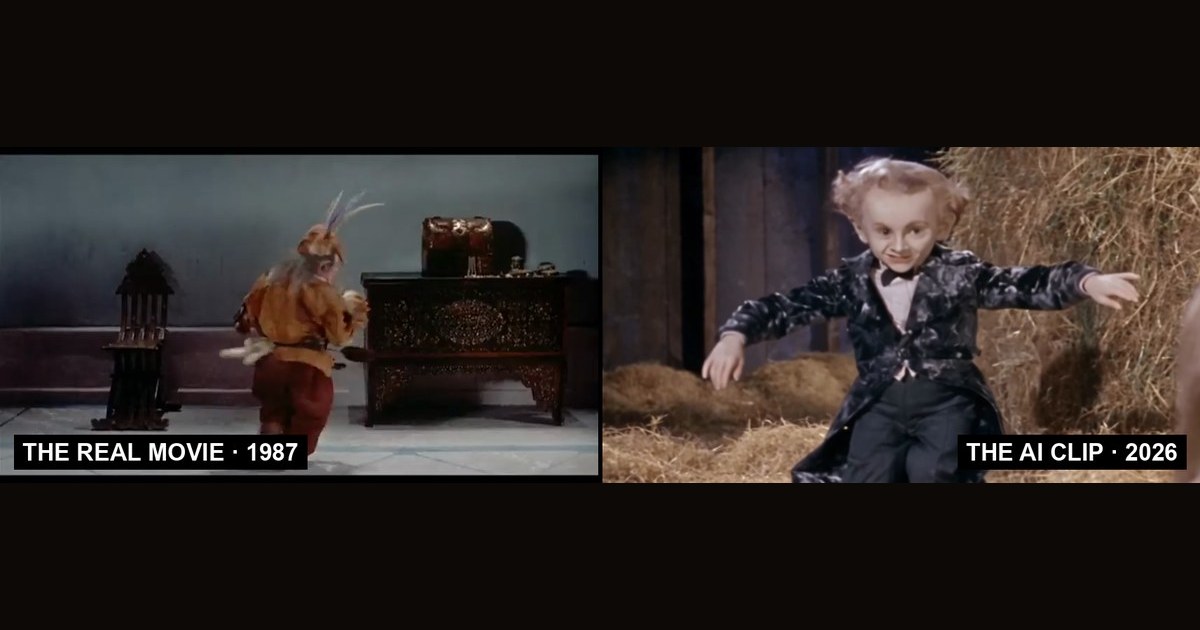
Here is the short version. The creepy clip of an imp tiptoeing across a candlelit barn while a princess watches is not from a real movie; it is AI-generated, posted to Instagram on August 27, 2026. But here is the twist that keeps the argument alive: a real movie called Rumpelstiltskin really did come out in 1987, and it really does have a dancing little man in it. The viral clip is not from that film, shares no footage with it, and looks nothing like it.
That coincidence is the whole story. This piece lays out the real film's history, puts the two side by side, explains why the forgery was so believable, and gives you a quick test for spotting fake "lost films" in your feed. If you only want the full meme backstory, the first explainer covers the origin, the Riff Raff song, and the fairy tale.
A vintage title card that lied
Most people met the clip through a repost, and most reposts carry the same prop: a title card styled like the opening of an old film. "Rumpelstiltskin (1987)" is the common version; some viewers walked away remembering the 1960s. The card does enormous work. It tells you the footage is old, official, and archival before you have seen a single frame, and your eyes spend the next twelve seconds confirming what the caption already claimed.
Left: the real 1987 Cannon film. Right: the AI clip that borrowed its year.
Not everyone took the card at face value. Within days, people were asking movie-identification communities in good faith. One thread on Reddit's r/whatsthemoviecalled asks simply "What movie is this?", and the top answer is the correct one: an AI-generated clip made to look like old cinema. By the second week of October 2026, the question had grown loud enough that Yahoo, LADbible, and Bored Panda all ran pieces settling it, and Tubi, the service that streams the actual 1987 movie, published its own note clarifying that the dancing everyone was watching is not in its catalog's film.
Yes, a real Rumpelstiltskin movie came out in 1987
The film exists, and its backstory is stranger than the meme suggests. In the mid-1980s, Cannon Films, the famously chaotic studio of Menahem Golan and Yoram Globus, committed roughly $50 million to adapting sixteen fairy tales as live-action musicals, a line branded Cannon Movie Tales. Rumpelstiltskin was the first of them released in the United States, premiering in April 1987 and later opening Cannon's family-film showcase at the 1987 Cannes Film Festival.
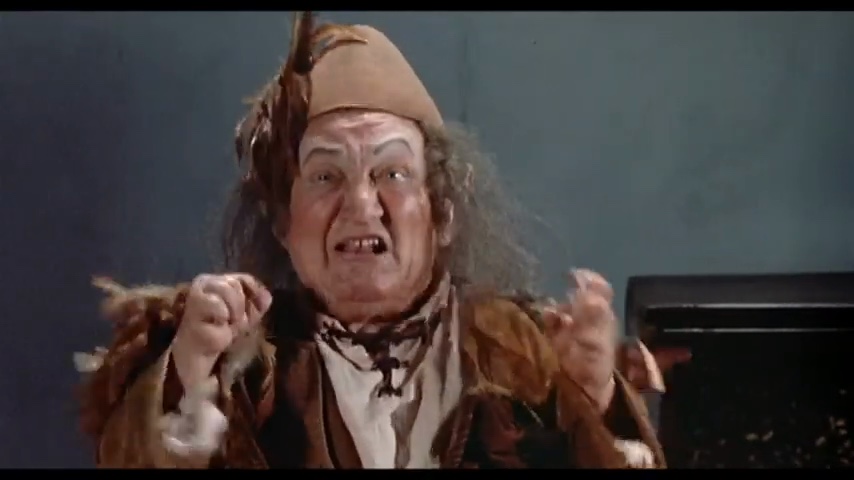
Billy Barty as the real 1987 Rumpelstiltskin, from the film's trailer.
The cast is a family affair wrapped around a Hollywood veteran. Billy Barty, the actor and activist who had worked in film since the 1920s, plays Rumpelstiltskin; it was his only lead role in a feature. Amy Irving plays Katie, the miller's daughter; her brother David Irving directed; their mother, Priscilla Pointer, plays the Queen; Clive Revill rounds things out as the villainous King Mezzer. It was shot in Israel on a $2 million budget, runs 84 minutes, and is a musical, with songs by Max Robert.
Reviews were not kind. Leonard Maltin gave it two stars and figured it would "bore even the small fry"; The Washington Post's verdict was that Cannon had managed to "make a short story long." The film faded into VHS rentals and cable reruns, found a modest second life on DVD in 2005, and now streams free on Tubi, which is exactly why a fake vintage caption naming the year 1987 had a real movie to hide behind.
Side by side: the 1987 film vs. the viral clip
Put the two next to each other and the "same movie" theory falls apart in seconds. They agree on exactly one thing: a small magical man associated with straw and gold. Everything else diverges.
| The real 1987 film | The viral clip | |
|---|---|---|
| The imp | A court jester in a feathered cap and bright costume | A grimy barn creature in tattered medieval rags |
| The setting | Palace interiors, stone halls, storybook sets | One candlelit barn full of straw |
| The look | Clean, brightly lit studio 35mm, musical colors | Heavy grain, halation, deep shadows, horror lighting |
| The dance | Barty prances through the frame like stage comedy | A slow, deliberate, uncanny tiptoe |
| The tone | Saturday-morning fairy tale | Dark fantasy that feels one scene from a jump scare |
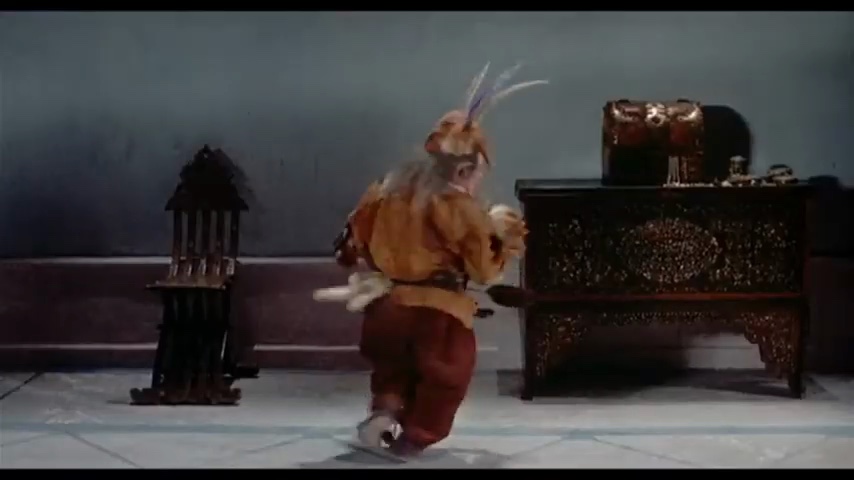
The real film's dancing Rumpelstiltskin, from the trailer: a jester's prance, not a tiptoe.
The woman in each version differs just as much. Amy Irving's Katie is the active protagonist of a musical; the clip's princess sits silent in the straw, watching, and exists to sell the eeriness. No costume, set, actor, or frame is shared between them. The clip is not an excerpt from a lost film, a deleted scene, or an obscure co-production. It is younger than most phone contracts.
Why "it's from 1987" was so believable
The confusion was not stupidity; it was a well-built illusion. Four things stacked up.
A real movie with that exact title and year exists. Search "Rumpelstiltskin 1987" and you find a Wikipedia page, an IMDb entry, a streaming listing. Every result is genuine; none of them contain the barn. The fake caption borrowed a true fact as camouflage, which is what good forgeries do.
People had already seen an old Rumpelstiltskin dance. A separate TikTok mashup had circulated pairing the real 1987 movie with Tiny Tim's "Tiptoe Through the Tulips." So by the time the AI clip arrived, a decent number of people genuinely remembered "an old film where Rumpelstiltskin dances." Two dancing imps were loose in the culture, one real and one synthetic, and memories blended them.
The AI copies the era's film language. As LADbible's write-up put it, the video model effectively scraped its training data for the tropes and the look of vintage fantasy cinema: 35mm grain, candle halation, soft focus, muted warm grading. The clip imitates the era of The Dark Crystal and Legend, a look audiences associate with "real movie I half-remember from childhood."
The grain hides the tells. The very artifacts that make old film look old also mask the artifacts that give AI video away. The forgery's paper texture is its disguise.
The ten-second test for fake "lost films"
This meme will not be the last one styled as archival footage, so here is the checklist.
- Search the exact title and year. Real films leave a paper trail: cast, crew, reviews, a distributor, a poster. If the only results are reposts of the same clip, there is no movie.
- Check the hands, feet, and teeth. Still the fastest failure points of AI video, especially in motion.
- Watch how the grain behaves. Photochemical grain flickers and shifts organically, frame to frame. Applied "vintage" texture tends to sit on the image like a sticker, repeating its pattern.
- Reverse-search one frame. A real film still leads you to reviews, databases, and sales listings. An AI frame leads you to ten more reposts.
- Ask what the account normally posts. Film-history archives and AI-art pages have very different feeds.
The barn clip fails checks one and four instantly: the scene appears nowhere in any catalog, because there is no catalog entry to appear in.
Where to watch the real 1987 film
If the meme sent you hunting for the actual movie, it is genuinely available: the 1987 Rumpelstiltskin streams free on Tubi and is listed on Prime Video, with a 2005 MGM DVD and the occasional 35mm reel trading among collectors on eBay. Go in with the right expectations: it is a bright, songs-between-scenes fairy-tale musical for children, not the candlelit horror the title card promised you.
If what you actually want is the creepy barn, that never existed, so nobody can stream it for you. You would have to generate it yourself, which is exactly what the original creators did and exactly what the Rumpelstiltskin AI studio is for.
Make your own "lost film"
The viral clip works as a meme because the scene is a template: one imp, one watching princess, one barn. The Rumpelstiltskin AI studio recreates it around the two portraits you choose, in three steps:
- Pick your cast. One photo plays The Imp, one plays The Princess. Anyone works: you, a friend, a couple, a dog with excellent posture.
- Generate the 12-second scene. The studio renders the tiptoe dance in the same grainy 1980s dark-fantasy style as the original, vertical or widescreen.
- Add the sound. The clip ships as a silent MP4; drop Riff Raff's "TIP TOE WING IN MY JAWWDINZ" on it in TikTok or CapCut to join the meme proper.
Credits start at $19.90; sizes are on the pricing page, and the homepage examples show the style before you spend anything. For the full history of the meme, the song, and the Grimm original, start with the first explainer.
FAQ
Is Rumpelstiltskin (1987) a real movie?
Yes. Rumpelstiltskin is a 1987 musical fantasy from Cannon Films' Cannon Movie Tales line, directed by David Irving and starring Amy Irving as the miller's daughter and Billy Barty as Rumpelstiltskin. It premiered in April 1987 and currently streams free on Tubi.
Is the viral Rumpelstiltskin dance clip from the 1987 movie?
No. The tiptoe clip is AI-generated, first posted to Instagram on August 27, 2026 by AI-art accounts. It shares no footage, actors, sets, or costumes with the real 1987 film.
What movie is the Rumpelstiltskin tiptoe dance from?
None. The clip is entirely AI-generated; "Rumpelstiltskin (1987)" is a fan-made caption styled like a vintage title card, not a citation. For how the clip actually started, see the origin story here.
Who plays Rumpelstiltskin in the 1987 movie?
Billy Barty, whose career in film stretched back to the 1920s; the 1987 lead was his only starring feature role. The imp in the viral clip is not an actor at all.
Is the viral clip from Shrek?
No. DreamWorks' Rumpelstiltskin is a separate character design from the Shrek films, and the viral imp is an original design styled after 1980s dark fantasy. The clip has no connection to DreamWorks.
Where can I watch the real 1987 Rumpelstiltskin movie?
The film streams free on Tubi and is listed on Prime Video as of October 2026. MGM released it on DVD in 2005, and original 35mm reels occasionally surface on eBay.
The debate settled, the real film streaming, and the fake one reproducible: if you want to see yourself in the barn, the studio is one click away.